Saturday, December 18, 2021

Erucarum Ortus

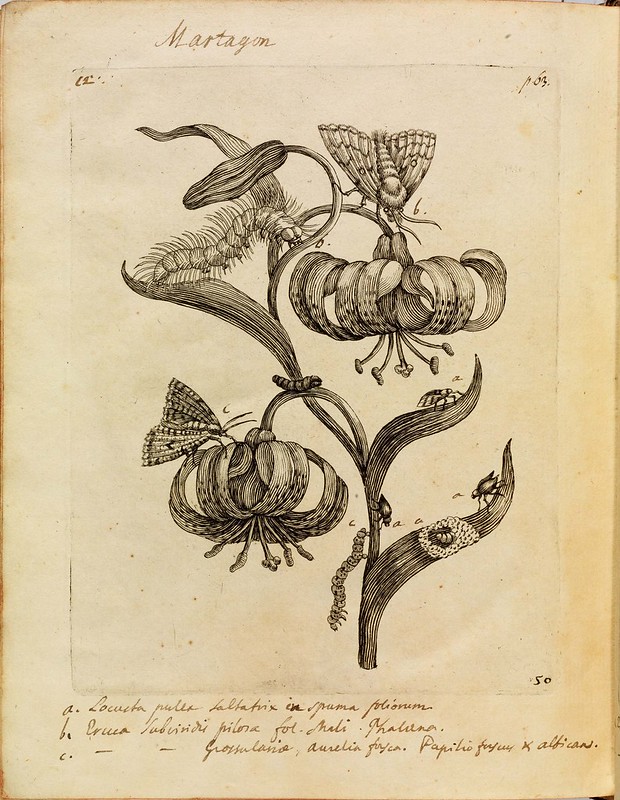
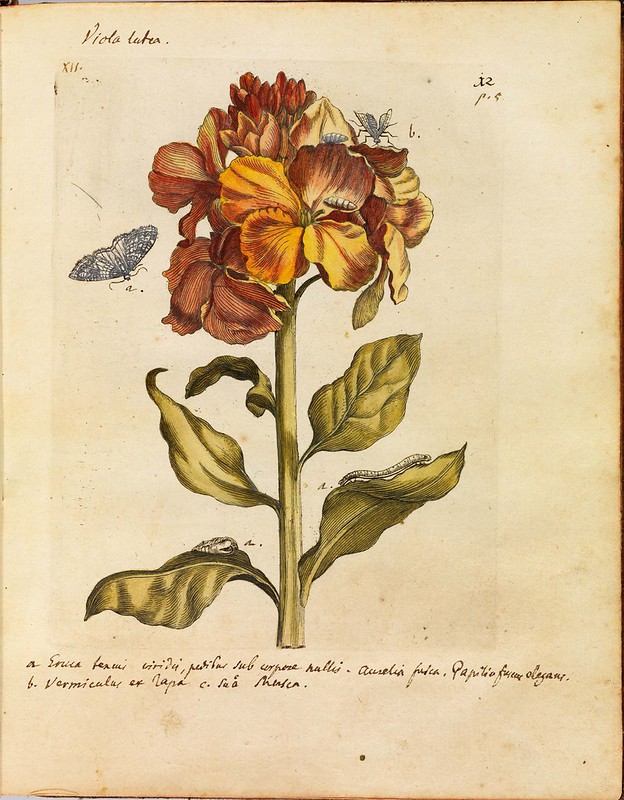
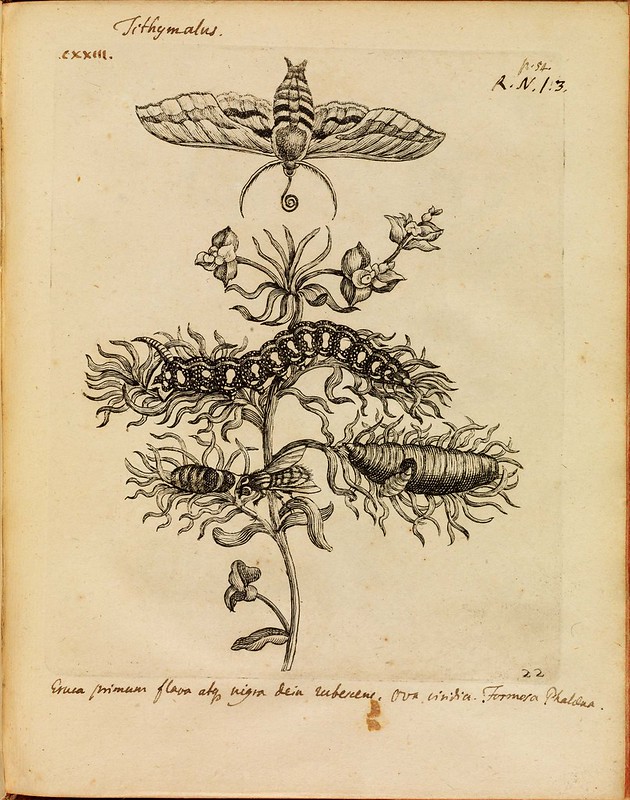
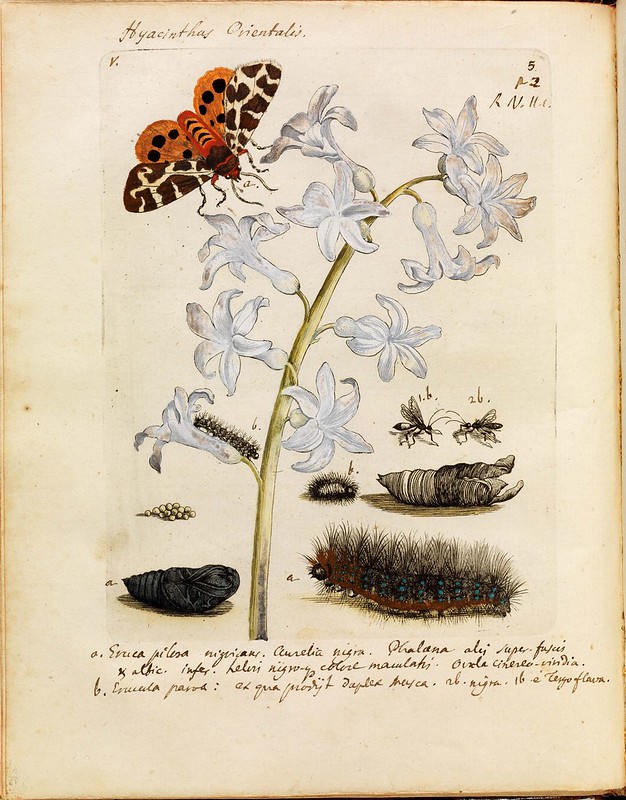
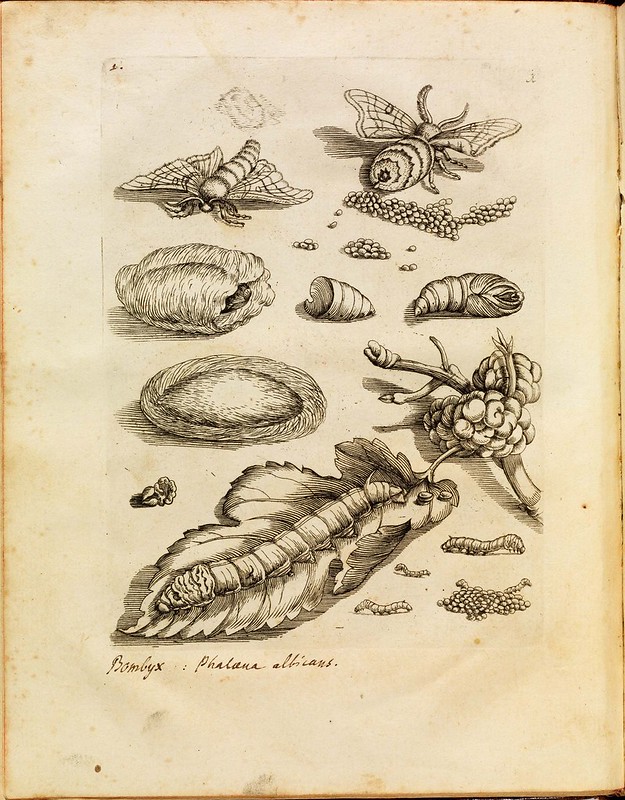
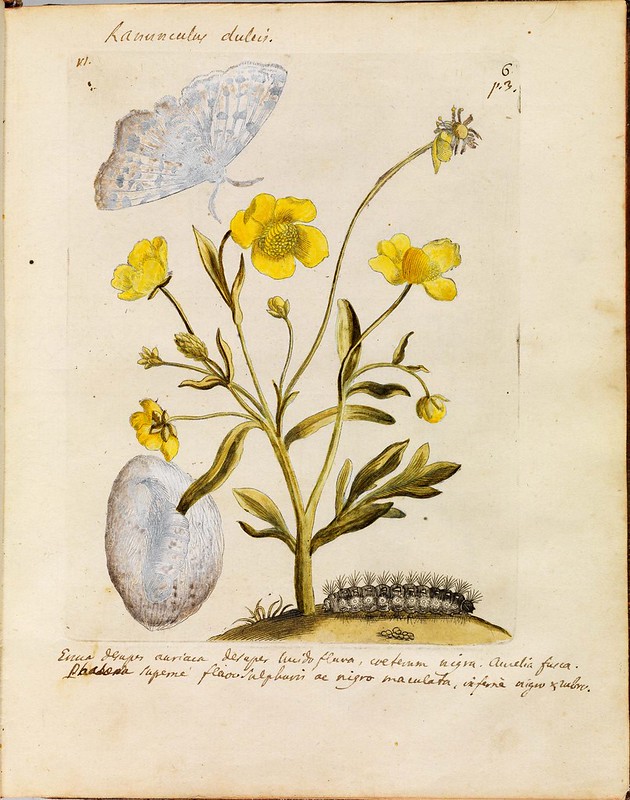
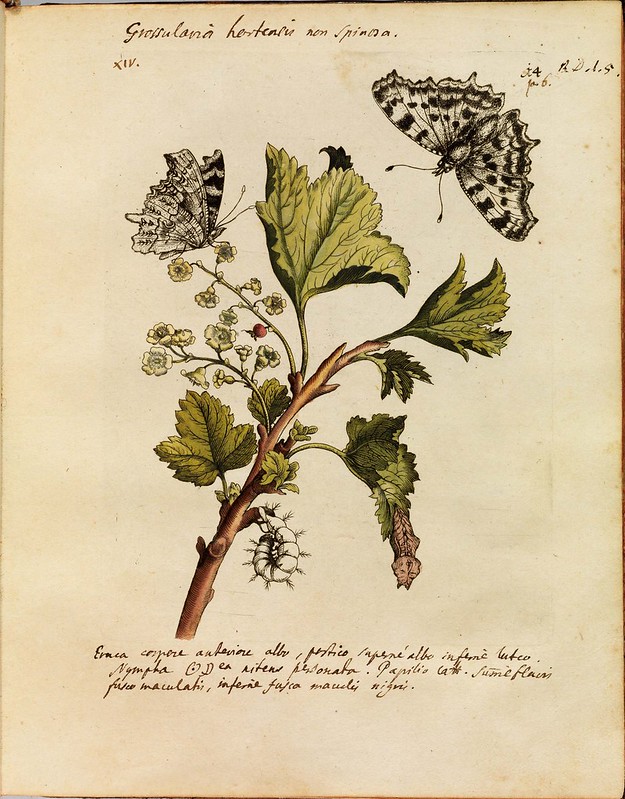
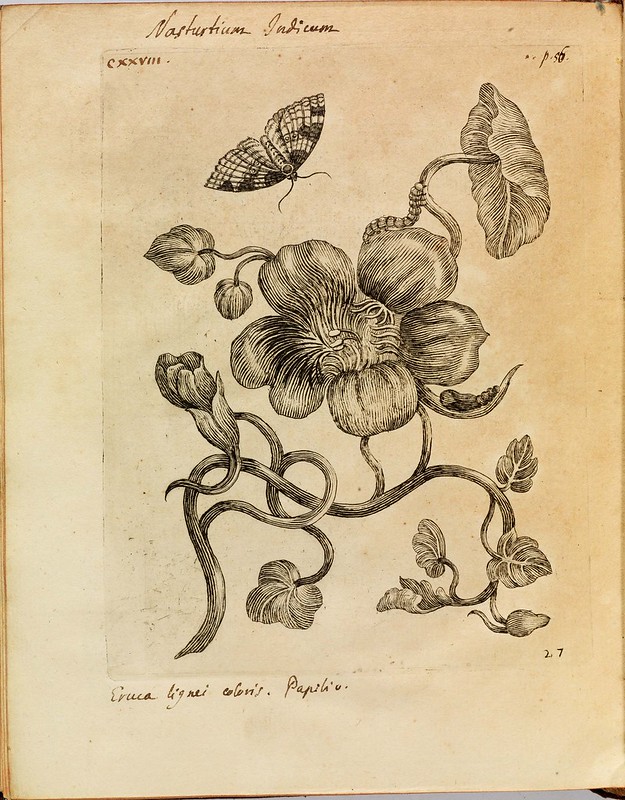
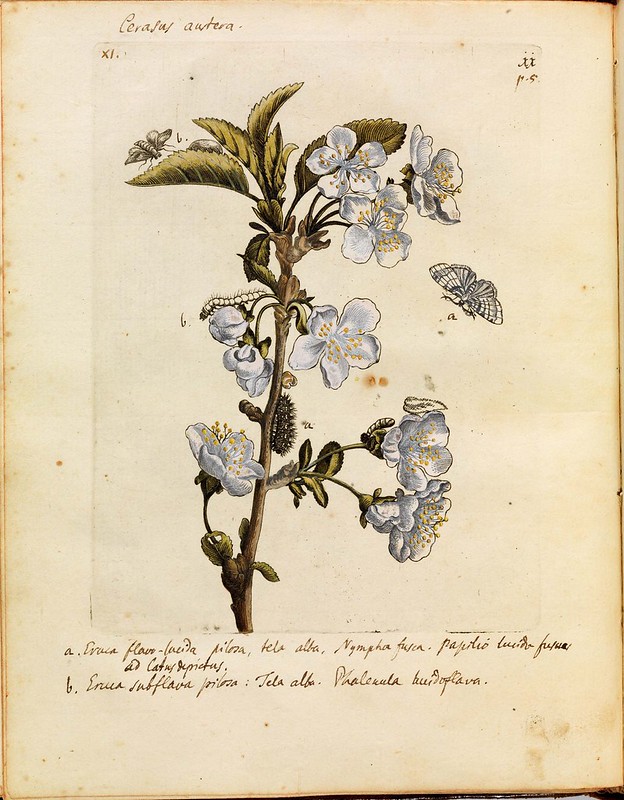
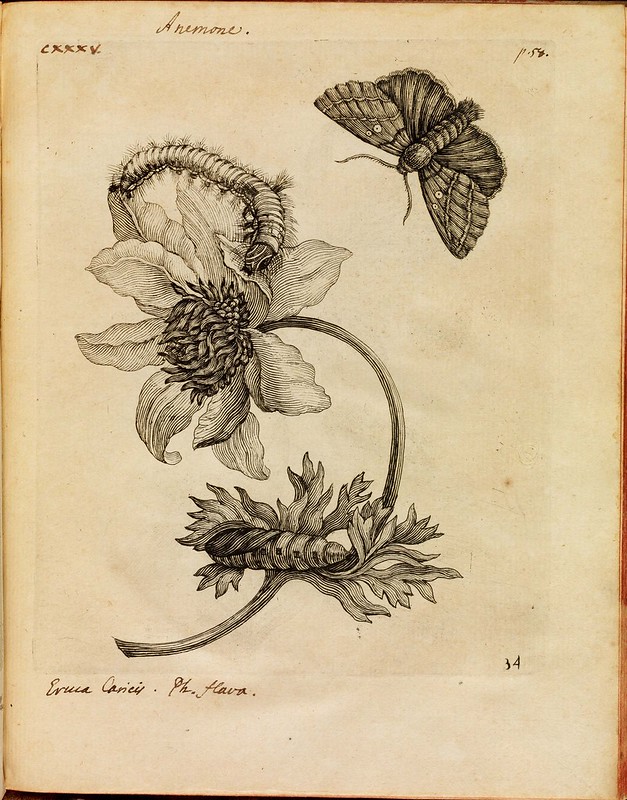
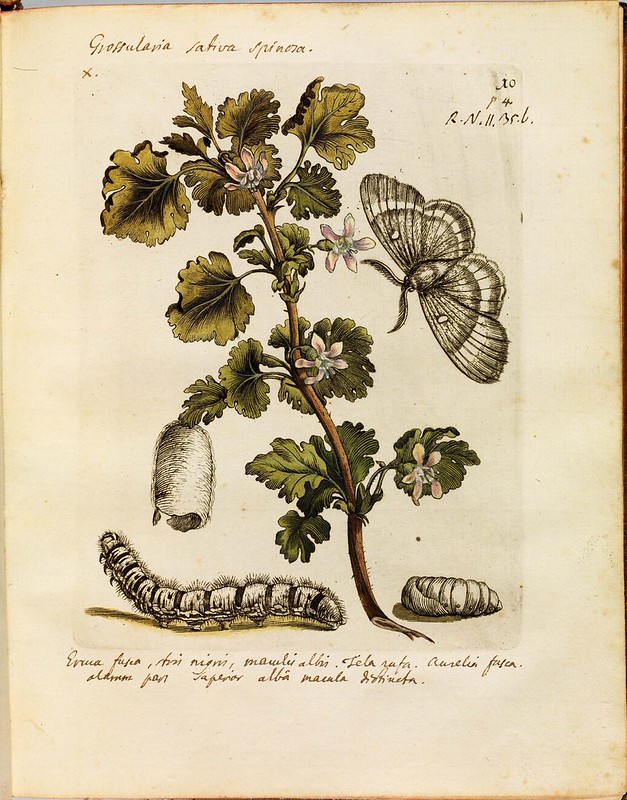
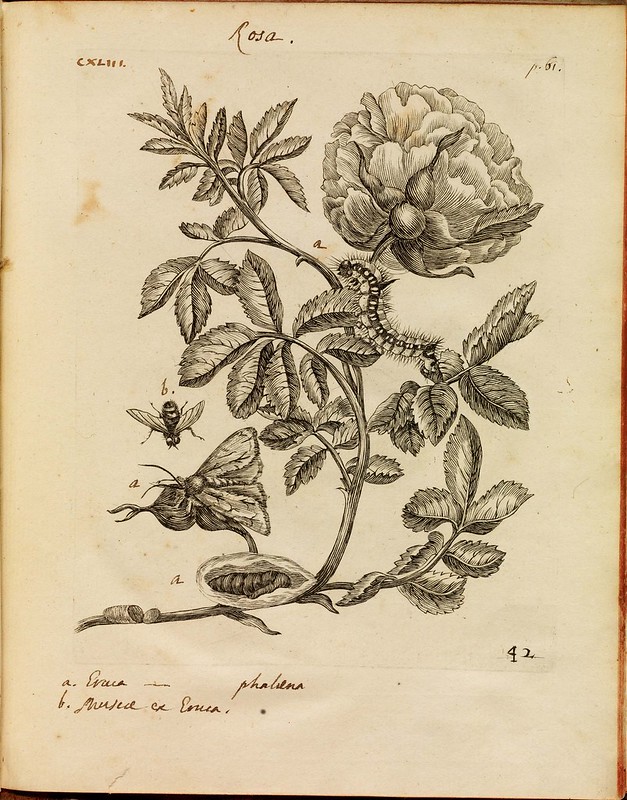
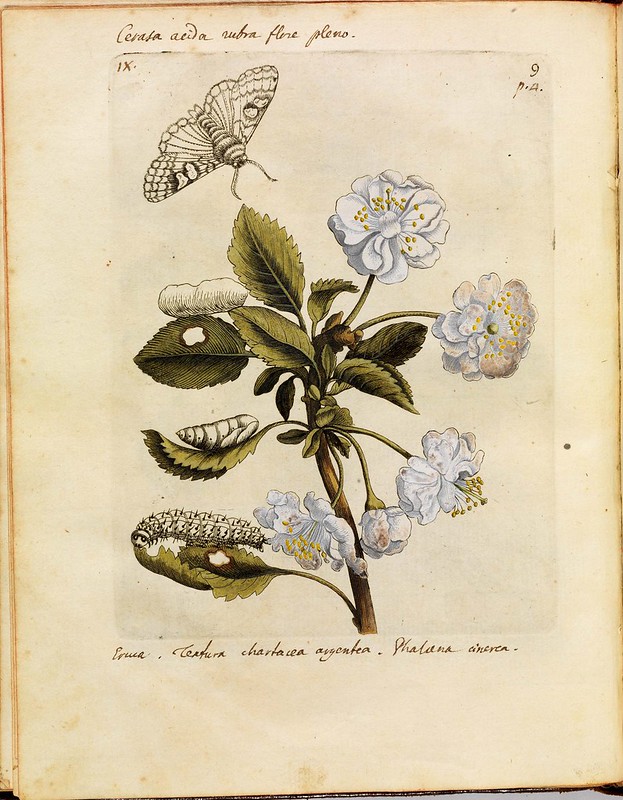
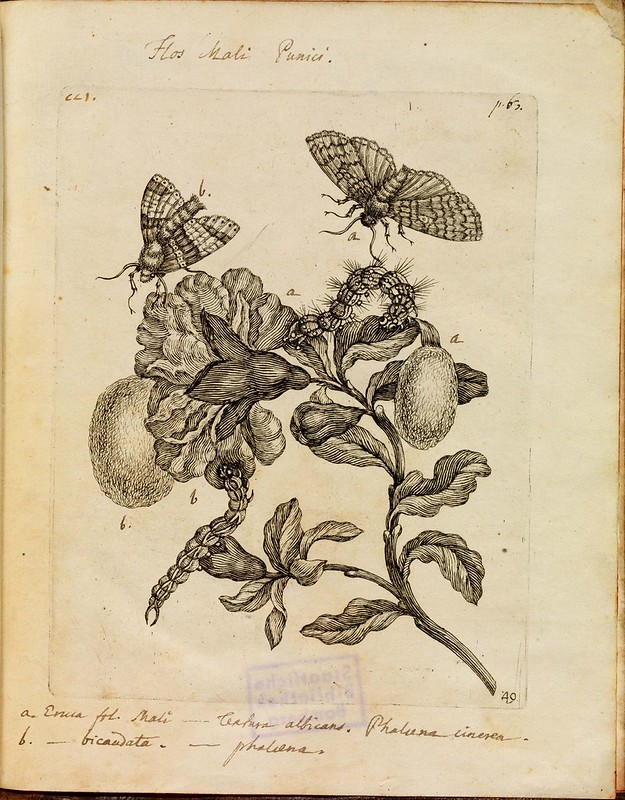
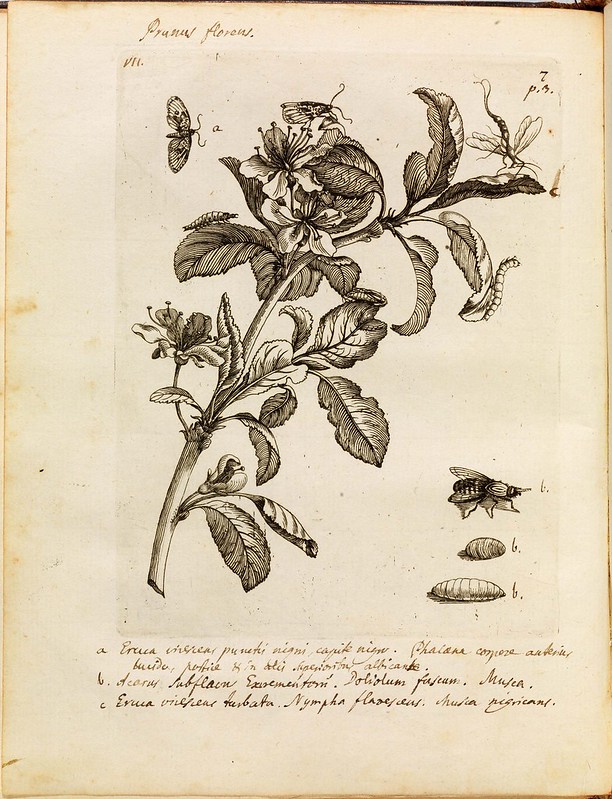
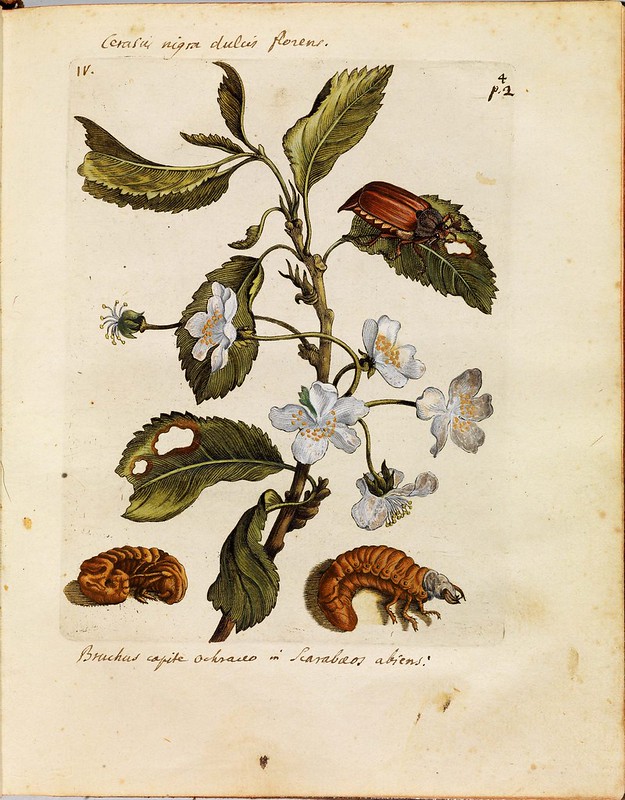
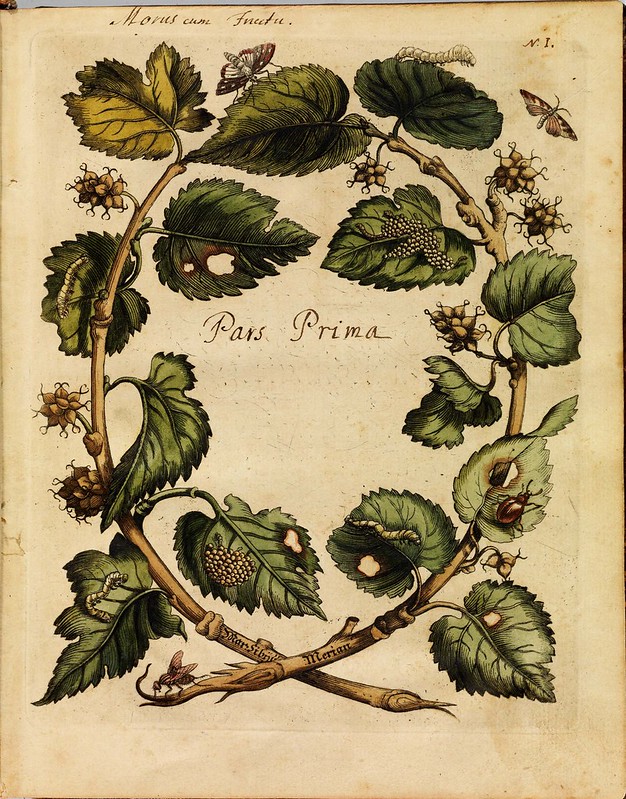
The illustrations below were designed by the German artist and naturalist, Maria Sibylla Merian. The plates were originally prepared for a mid-1670s book on the metamorphosis of caterpillars into butterflies. However, the scientific community of the time largely ignored Merian's work because it wasn't published in Latin, the formal language of science.

Some forty years later, Merian finally reworked and expanded this earlier book on European insects. Sadly, she died shortly before the completed book - in Latin, finally - was readied for publication in 1717 as 'Erucarum Ortus..'. The full title of the book is said to translate as: 'The Miraculous Transformation and Unusual Flower-Food of Caterpillars'.

Merian's portrayal of plants and insects in a semi-naturalistic way was something of a step forward in the world of scientific illustration. Many of her contemporaries 'arranged' the illustrated scenes to show man's domination over nature, or took liberties with embellishment to impress and dazzle the audience.

"For her period, her work is scientifically accurate and she is considered by modern scholars to be one of the founders of entomology, the study of insects." [source]
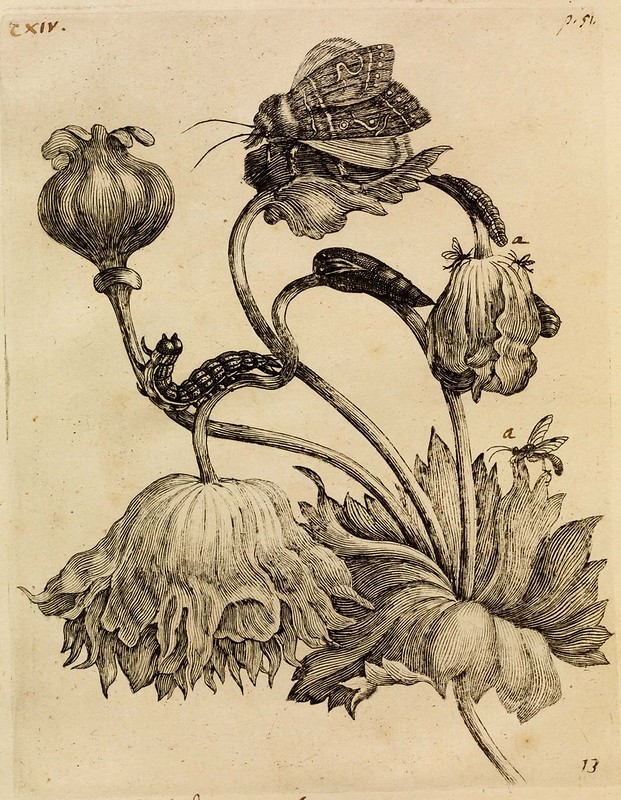
'Erucarum Ortus' features some 150 plates of butterflies, caterpillars, moths and other insects together with their associated plants. The book is divided into three sections and about half of the first section of illustrations - in this particular copy - has been enhanced with hand-colouring. The balance of engravings below were sampled from throughout the book. The opium poppy plate was cropped back to the engraving plate margin; all others were chopped off at the page edge. 


historical science B+W + colour engravings-illustrations of butterflies, bees, moths + plants + flowers in-situ (1700s)


historical science B+W + colour engravings-illustrations of butterflies, bees, moths + plants + flowers in-situ (1700s)

cropped engraving of opium poppy with associated grubs & moths
"Although the 'Erucarum Ortus' appeared one year after her death, Merian was very much involved in its publication. From at least 1705 she had intended to issue her work on European insects in Latin and Dutch, completing it with a third part. Ill health at the end of her life delayed publication of the third part until just after her death, but the complete Latin edition followed only one year later." [source]
Erucarum ortus - Maria Sibylla Merian


historical science B+W + colour engravings-illustrations of butterflies, bees, moths + plants + flowers in-situ (1700s)

historical science B+W + colour engravings-illustrations of butterflies, bees, moths + plants + flowers in-situ (1700s)

historical science B+W + colour engravings-illustrations of butterflies, bees, moths + plants + flowers in-situ (1700s)
'Among the most important works in her oeuvre is her work on the feeding and growth of European caterpillars ... because these volumes contain both illustrations and texts, they provide a wealth of insights into Merian's interests with respect to art and nature, the intentions she sought in her work and the public for whom that work was intended. A unique primary source of information about a baroque painter, [..] ['Erucarum Ortus, Alimentum et Paradoxa Metamorphosis'] is also an invaluable historical source as a document of the popularisation of natural history in the early Enlightenment period.' (Heidrun Ludwig, 'The Rapuenbuch. A popular natural history', in Maria Sibylla Merian 1647-1717 Artist and Naturalist 1998, p.53) [source].
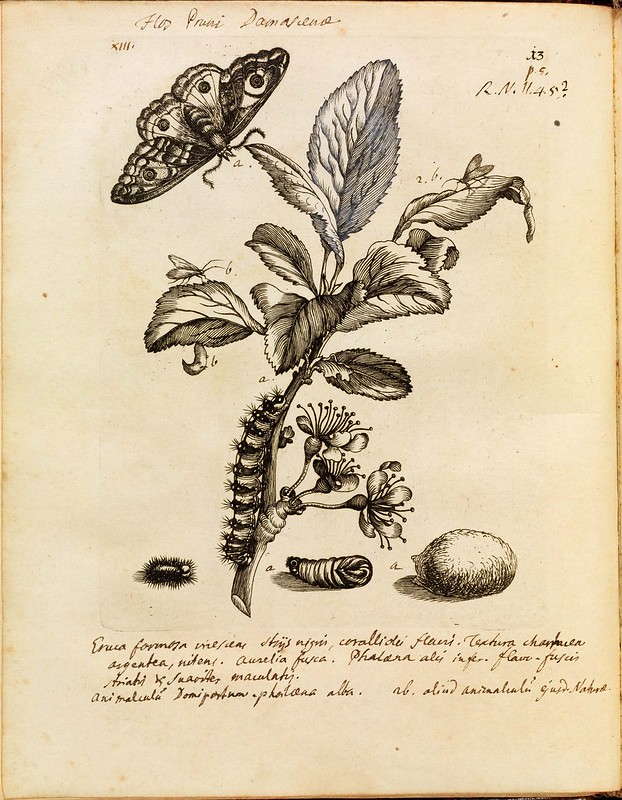
historical science B+W + colour engravings-illustrations of butterflies, bees, moths + plants + flowers in-situ (1700s)

historical science B+W + colour engravings-illustrations of butterflies, bees, moths + plants + flowers in-situ (1700s)

historical science B+W + colour engravings-illustrations of butterflies, bees, moths + plants + flowers in-situ (1700s)
"Maria Sibylla Merian (1647-1717) was one of the greatest artist-naturalists of her time. From childhood she had been fascinated by the life cycles of butterflies, and she made a close study of their transformations. She became a flower-painter and teacher in Nuremberg, Frankfurt and Amsterdam." [source]
"In 1711 Maria suffered a stroke and although greatly disabled, continued her work for a further six years. she died in Amsterdam on 13th January, 1717. The register of deaths lists her as a pauper, but in spite of this she had her own grave. In the same year her daughter published for the first time all three parts of her mothers life's work under the title 'Erucarum Ortus Alimentum et Paradoxa Metamorphosis' [..]
There are a number of versions of how the entire works of this extraordinary woman ended up in Russia. the most reliable record is that the works were purchased by Tsar Peter the Great, personally, during a visit to western Europe, only days before Merian's death in 1717. Upon the Tsar's death in 1725, the works were presented to the Academy of Sciences [in Germany] where they reside today." [source]

Saturday, June 8, 2019

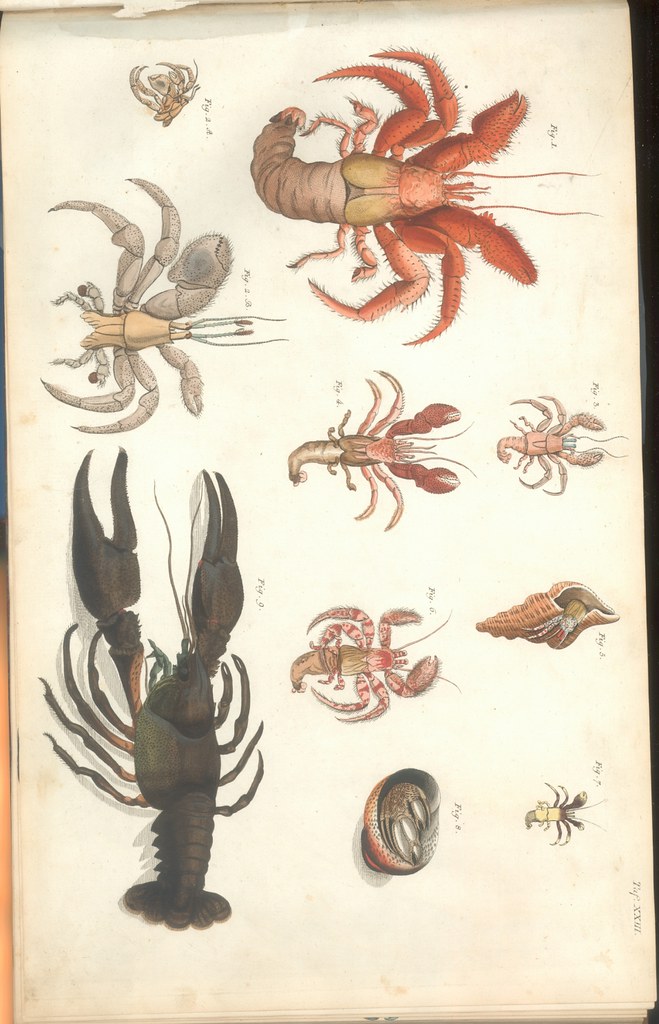
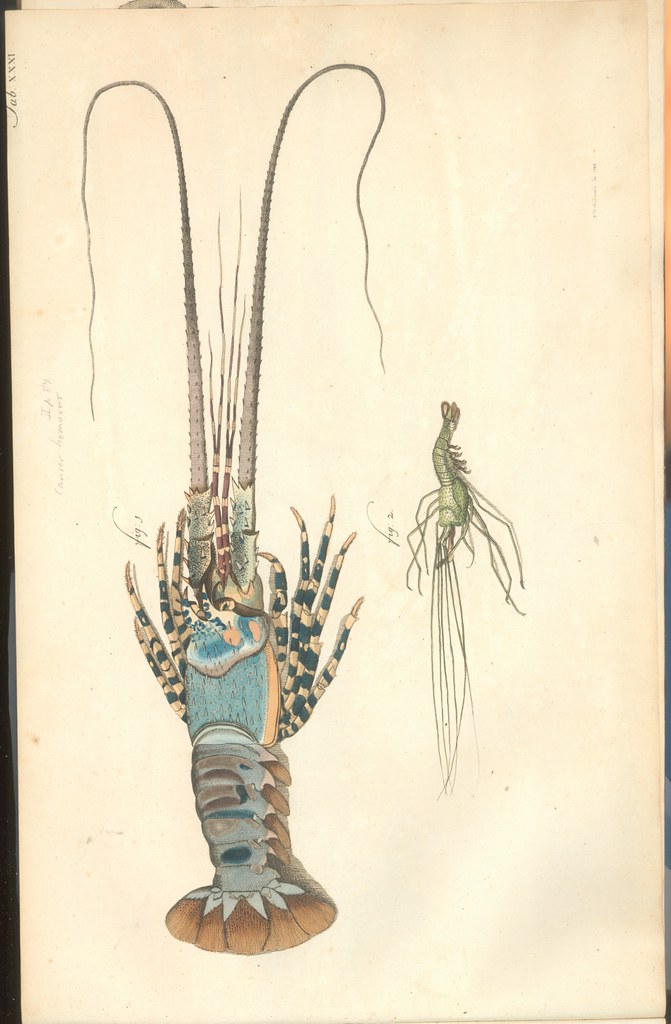
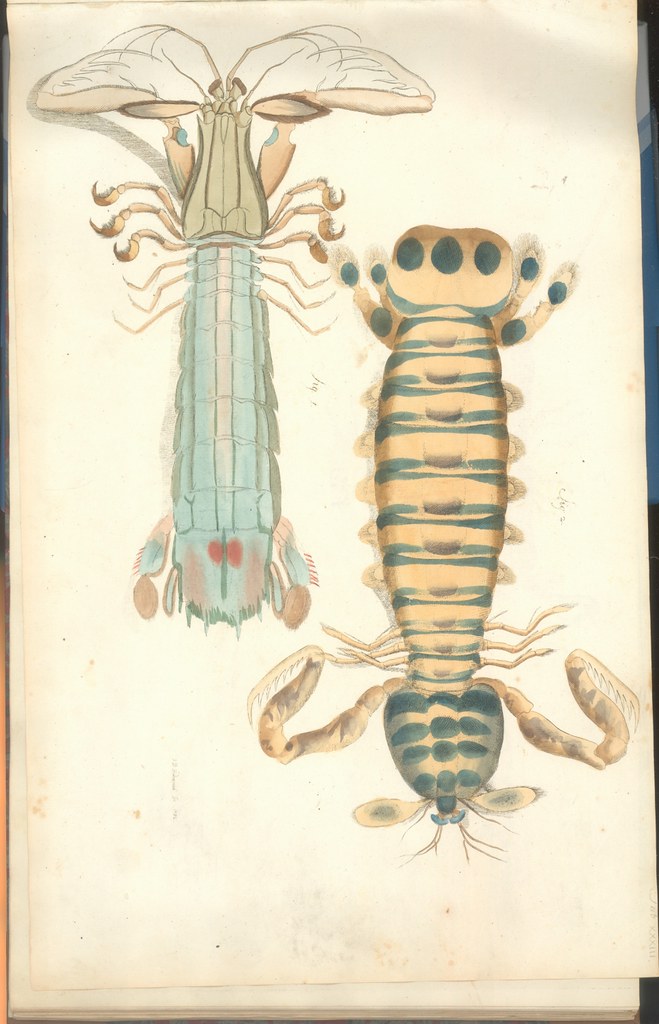
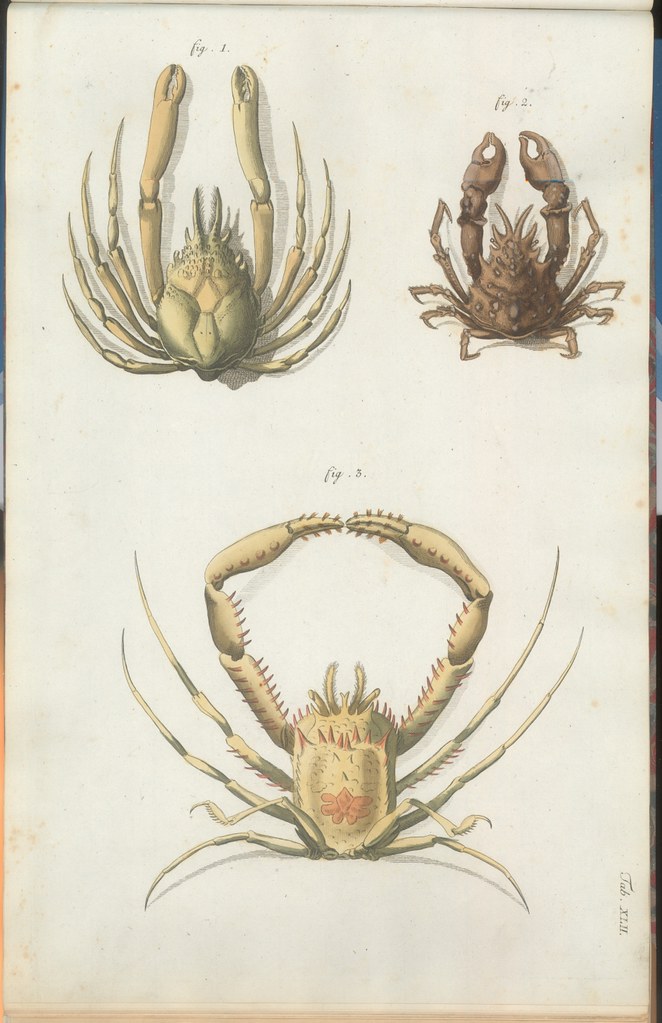
Crustacean Atlas

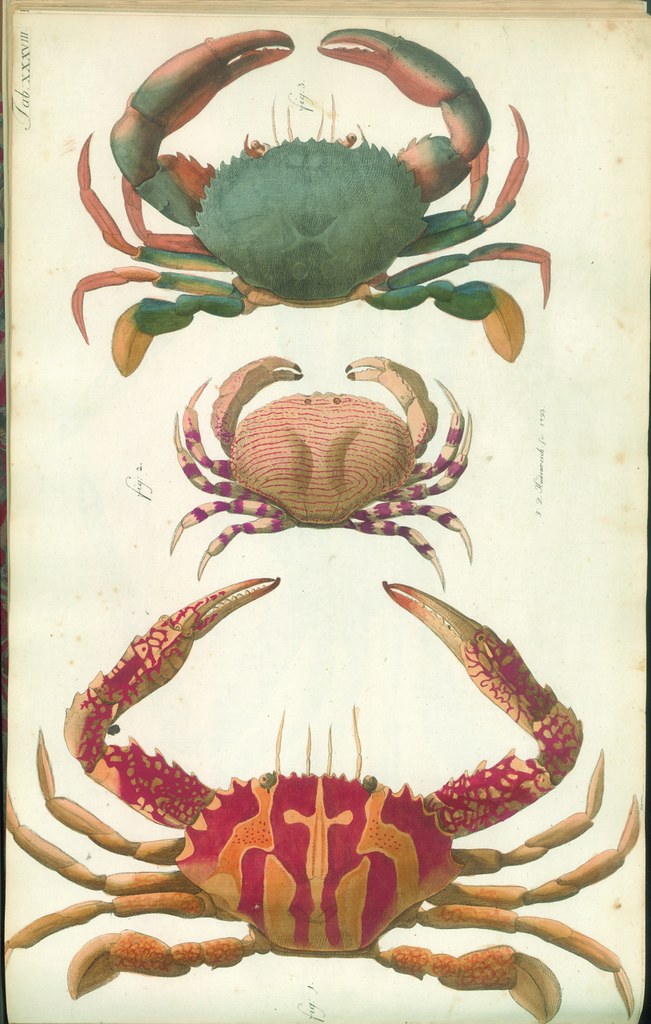
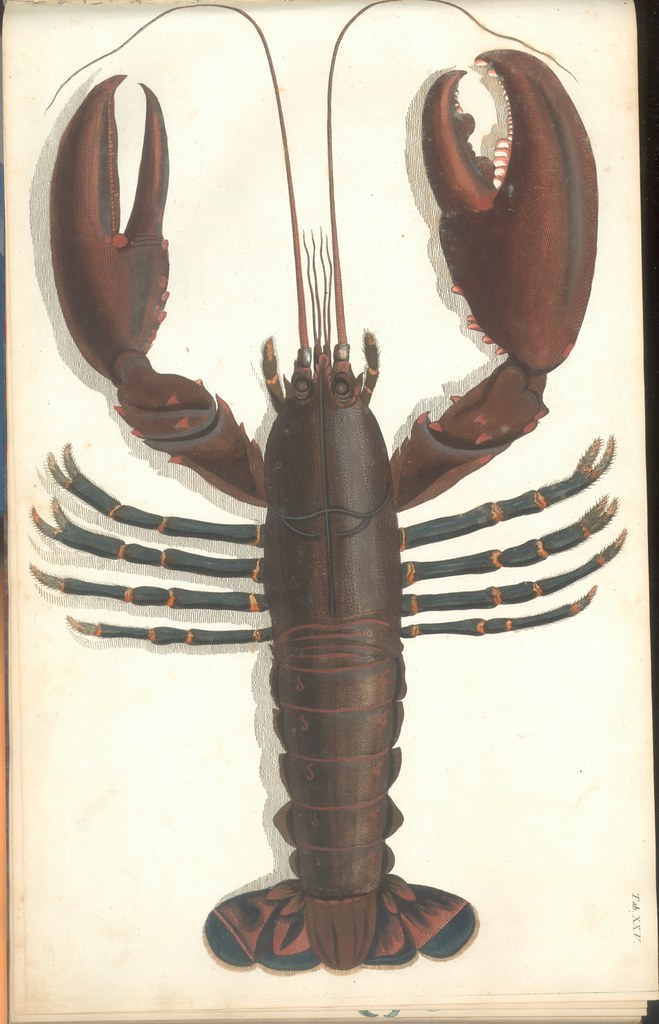
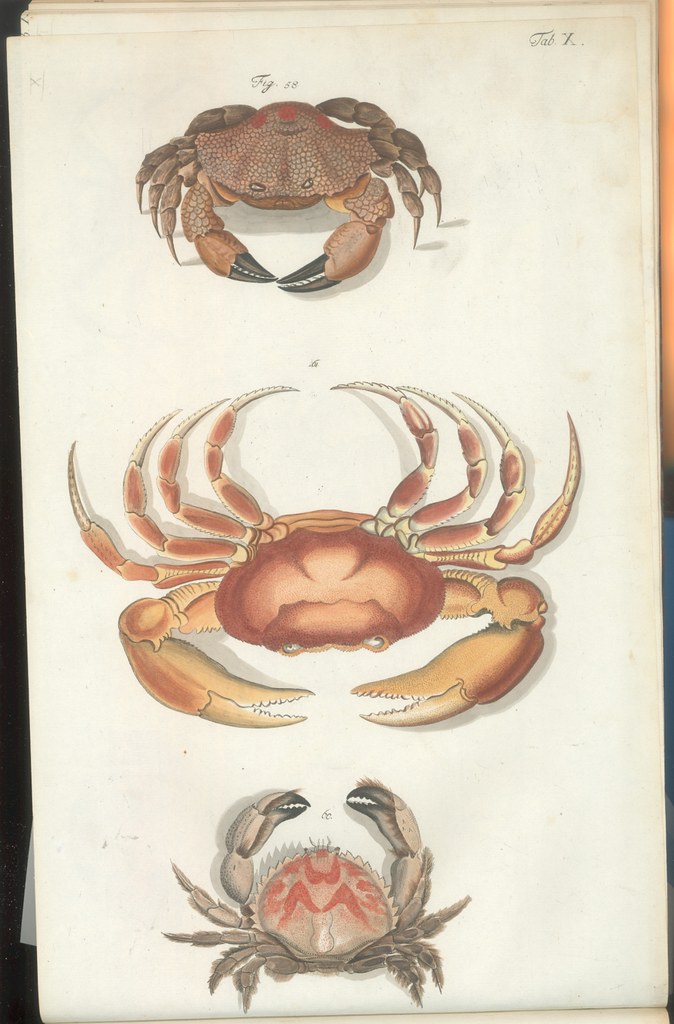
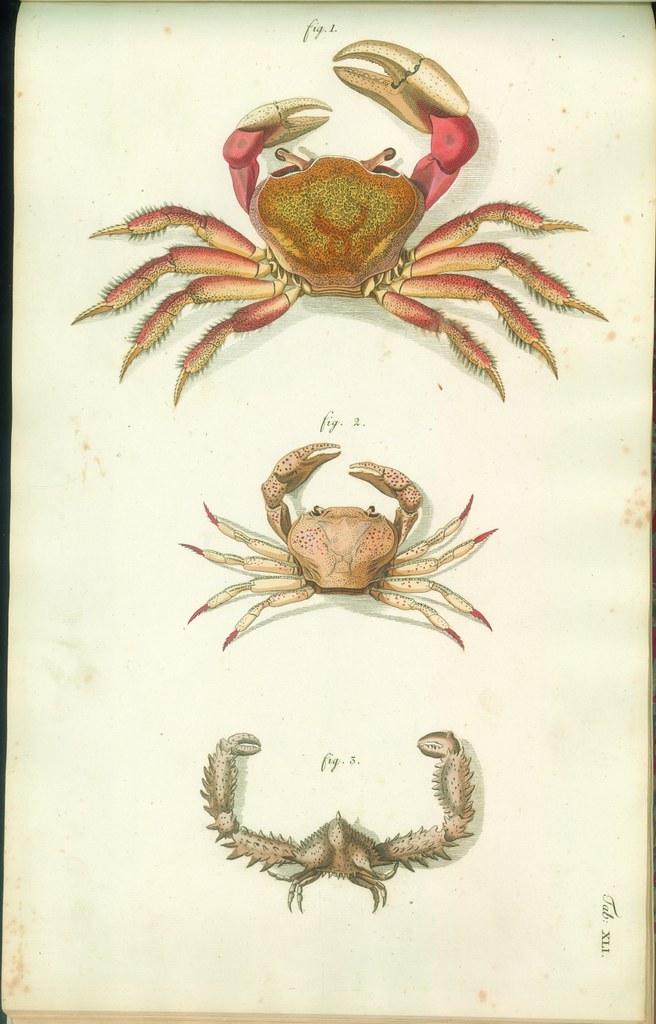
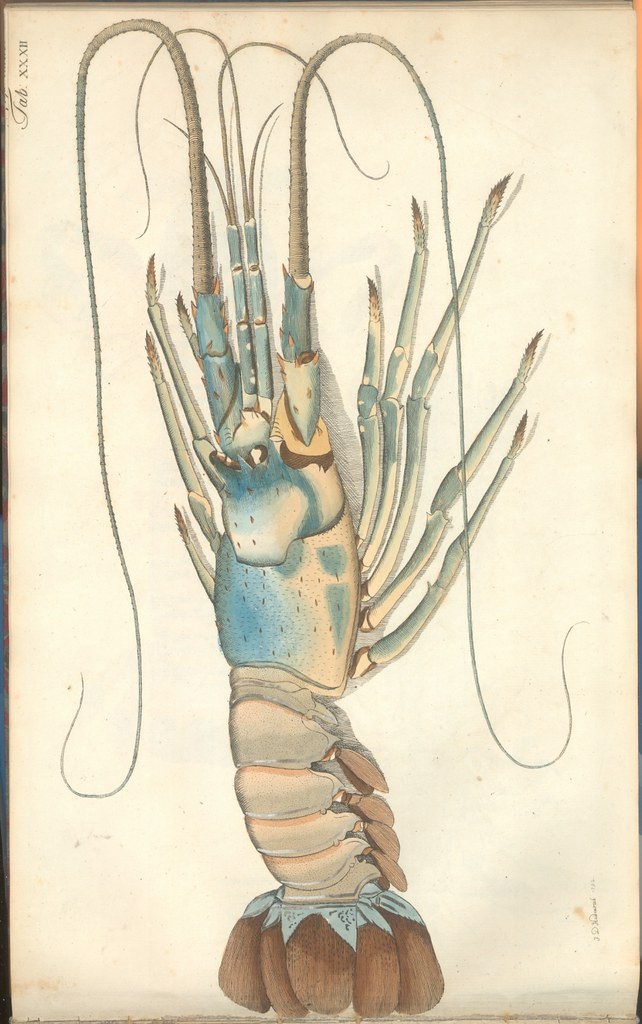
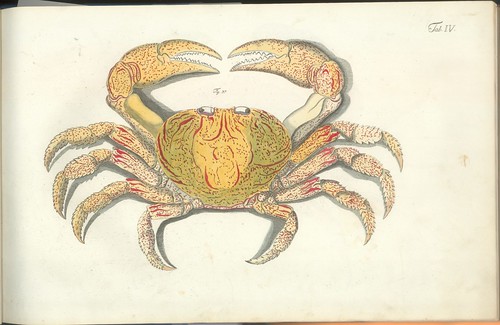
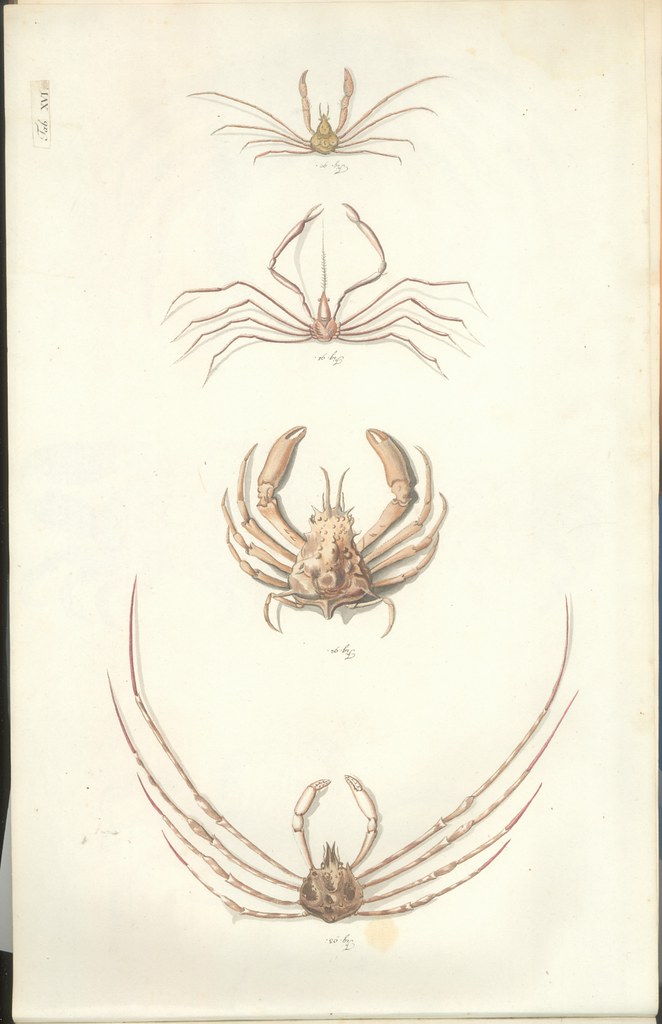
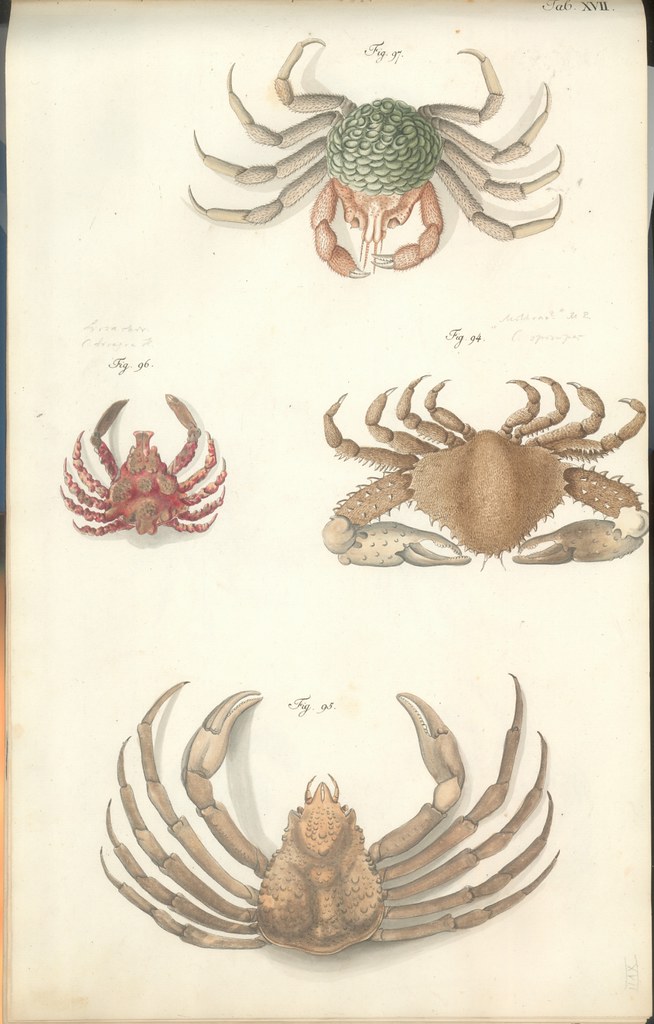
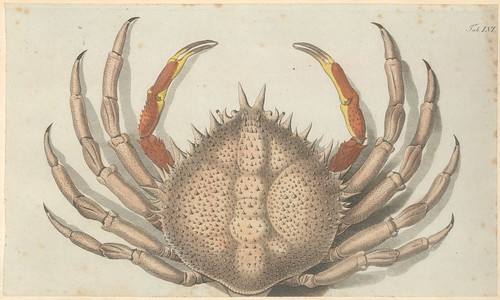
hand-coloured engravings of crabs


Versuch einer Naturgeschichte der Krabben und Krebse e


Versuch einer Naturgeschichte der Krabben und Krebse a


Versuch einer Naturgeschichte der Krabben und Krebse j


Versuch einer Naturgeschichte der Krabben und Krebse g


Versuch einer Naturgeschichte der Krabben und Krebse


Versuch einer Naturgeschichte der Krabben und Krebse b


18th c. hand-coloured engravings of crustacea


Versuch einer Naturgeschichte der Krabben und Krebse d


Herbst - 18th c engravings crustacea


Versuch einer Naturgeschichte der Krabben und Krebse h


Versuch einer Naturgeschichte der Krabben und Krebse k


hand-coloured engraving of a crab from the 1700s by jfw herbst


Johann Friedrich Wilhelm Herbst (1743-1807) was a German naturalist and entomologist as well as a theologian and chaplain for the Prussian army.

Herbst was best known for helping Carl Jablonsky attempt to survey all known beetles (Order Colyoptera). The effort resulted in the massive, but still incomplete 'Naturgeschichte der in-und Ausländischen Insekten' (1785-1806) (see: iii)

The title of present interest - 'Versuch einer Naturgeschichte der Krabben und Krebse' ([An attempt at] The Natural History of Crabs and Lobsters) - was released in instalments between about 1782 and the mid-1790s. There were three volumes of text and an atlas consisting of more than sixty hand-coloured engravings. It appears various editions were issued before 1800, some coloured, some not and some coloured later : all having an impact on the auction price today (ranging from, say, $6K to $18K).

Herbst's crab and lobster book was - as far as I can tell - the first comprehensive work on the crustaceans and definitely included descriptions and illustrations of previously unknown species. It is still regarded as a primary source in the field.

Saturday, December 8, 2018

The Crimean War, 19th C

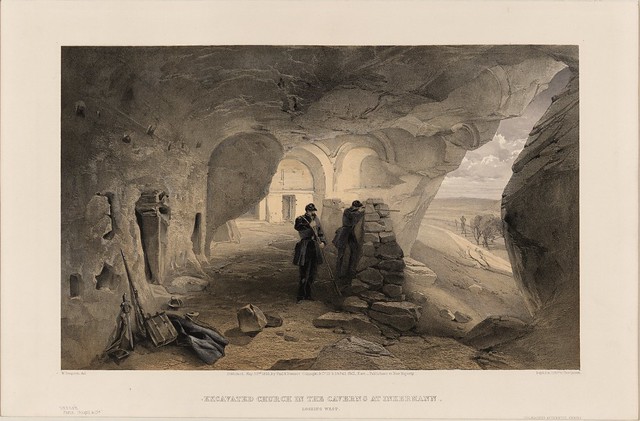
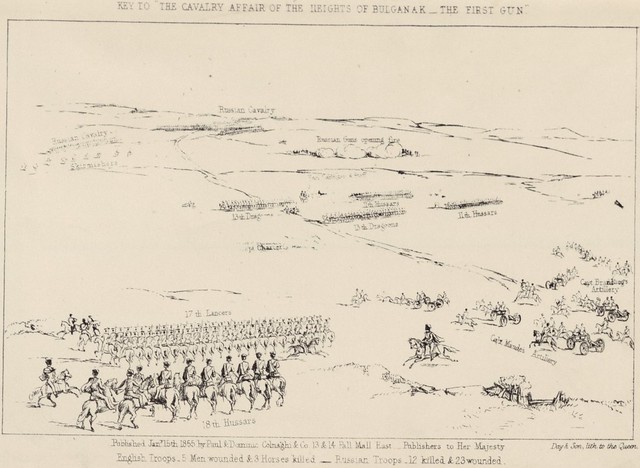
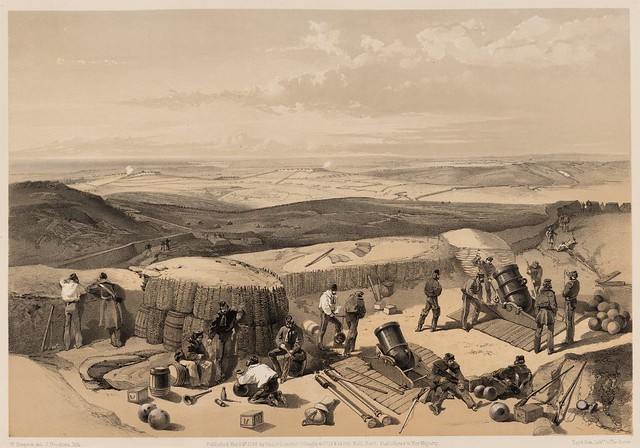
These lithographic scenes from the Crimean War, based on sketches by William Simpson, were published in London in a couple of series by Colnaghi & co. in the second half of the 1850s. The illustrations here are all derived from .tif downloads and the images themselves are cropped back to the edges of the mounted borders. The scene keys or legends were cut from the sides of their corresponding prints and the deficits filled in. A few images have had background stains removed.
"The Crimean War (1853-1856) was a conflict between the Russian Empire and an alliance of the French Empire, the British Empire, the Ottoman Empire, and the Kingdom of Sardinia. The war was part of a long-running contest between the major European powers for influence over territories of the declining Ottoman Empire. Most of the conflict took place on the Crimean Peninsula, but there were smaller campaigns in western Anatolia, Caucasus, the Baltic Sea, the Pacific Ocean and the White Sea. In Russia, this war is also known as the "Eastern War" and in Britain it was also called the "Russian War" at the time."

Interior of the Malakoff with the remains of the round tower

"Print shows an interior view of the Malakoff, the main Russian fortification before Sevastopol, following the successful French assault."

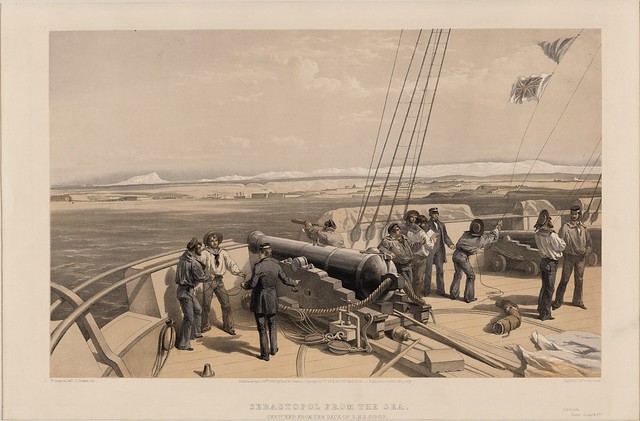
Sebastopol from the sea - sketched from the deck of H.M.S. Sidon
Key to Sebastopol from the sea - sketched from the deck of H.M.S. Sidon
Sebastopol from the sea - sketched from the deck of H.M.S. Sidon

"Print shows sailors and cannons on deck of the H.M.S. Sidon, with a distant view of the forts and other buildings in Sevastopol."

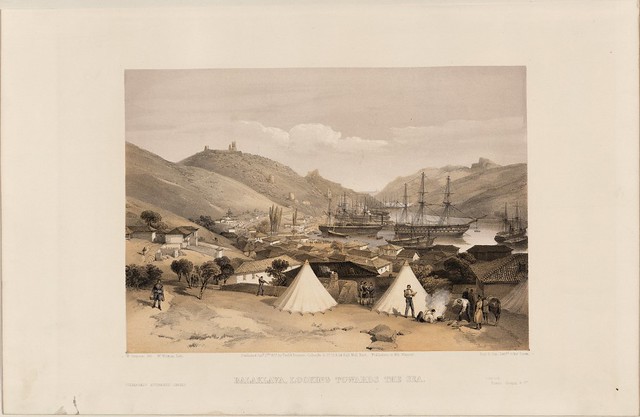
Balaklava, looking towards the sea

"Print shows view of Balaklava looking over the rooftops toward the harbor which is getting crowded with British ships; two bell tents in the foreground, and remains of an old castle on the hillside in the background."
"William Simpson arrived off the Crimean peninsular on November 15 and could hear distant firing. While he had missed the early battles, he was able to record the events before Sebastopol. He made numerous acquantances who helped him with details for his pictures, but he was also struck by the plight of the common soldiers, "miserable looking beings...covered with mud, dirt, and rags", he wrote. He hobnobbed with many officers including Lord Raglan and Captain Peel; he also met Roger Fenton who took his photograph. In May, 1855, Simpson accompanied Raglan on the expedition to Kertch which was captured on the 24th, but was back in time to observe the first attack on Sebastopol in June. On the night of the 17th, he crawled out of a trench to view the attack. He wrote, "It was a wild orchestra of sound, never to be forgotten." He was still at the front when the city finally surrendered, and he quit the Crimea in the autumn of 1855.

Throughout his time at the front, he would send back his watercolours to London where the lithographers of Day & Son would transfer them to stone. Simpson was paid 20 pounds for each picture. For the color, a separate stone was used for each tone. Colnaghis exhibited some of the watercolours, including a show at the Graphic Society in February 1855. The first advertisements for the lithographs appeared in May 1855 and in the following month, a second series was announced. In all, the Colnaghi's produced two large portfolios containing over eighty lightographs entitled The Seat of the War in the East. Two thousand copies of the complete set were produced. Simpson dedicated the series to Queen Victoria whose patronage he enjoyed for the rest of his life, and he was a frequent visitor to Windsor Castle and Balmoral. So popular were his pictures that he became affectionately known at 'Crimean Simpson'. [source]


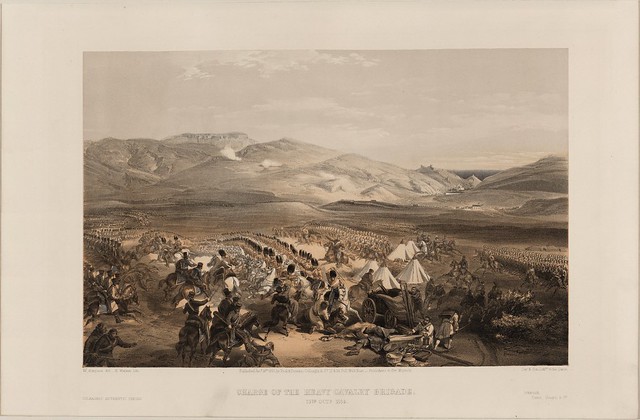
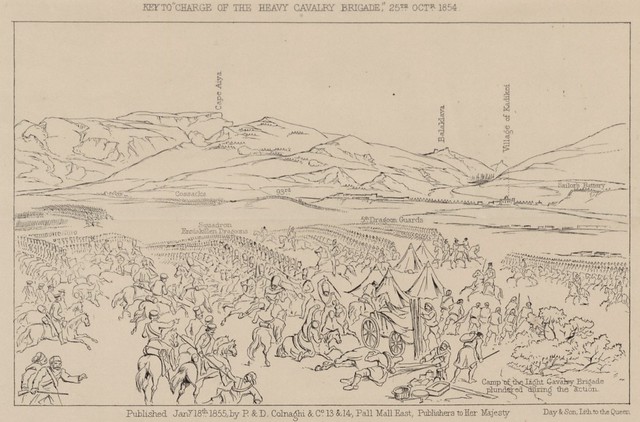
Charge of the heavy cavalry brigade, 25th Octr. 1854
Key to Charge of the Heavy Brigade (1854)
Charge of the heavy cavalry brigade, 25th Octr. 1854

"Print shows the Enniskillen Dragoons and the 5th Dragoon Guards engaging the Russian cavalry in the midst of the camp of the light cavalry brigade which is being plundered by the Russian troops during the battle of Balaklava."

The railway at Balaklava, looking south

"Print shows the railway under construction in Balaklava near the harbor, also shows masts of ships in the harbor and the ruins of the old Genoese castle on a hill in the background."

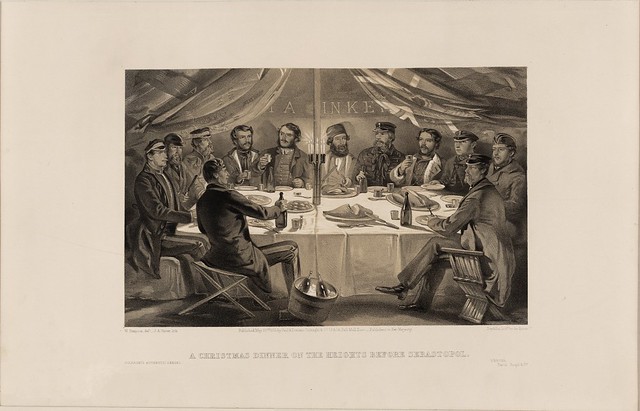
A Christmas dinner on the heights before Sebastopol
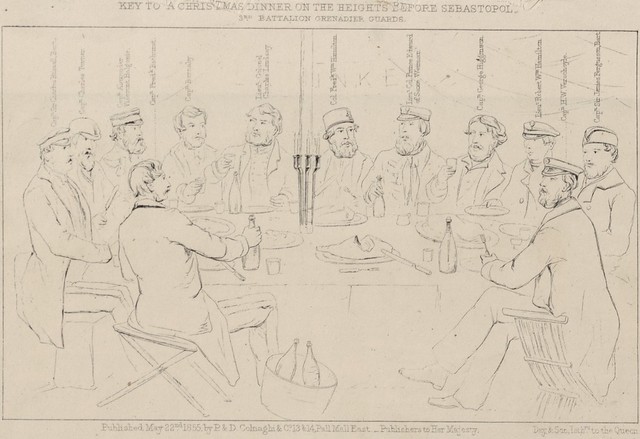
Key to A Christmas dinner on the heights before Sebastopol
A Christmas dinner on the heights before Sebastopol

"Print shows (from left) Capn. Sir Charles Russell, Bart, Capn. Charles Turner, Capn. Alexander Viscount Balgonie, Capn. Fredk. Bathurst, Capn. Burnaby, Lieut. Colonel Charles Lindsay, Col. Fredk. Wm. Hamilton, Lieut. Col. Prince Edward of Saxe Weimar, Capn. George Higginson, Lieut. Robert Wm. Hamilton, Capn. H.W. Verschoyle, and Capn. Sir James Fergusson, Bart seated around a table in a tent, enjoying a Christmas dinner."

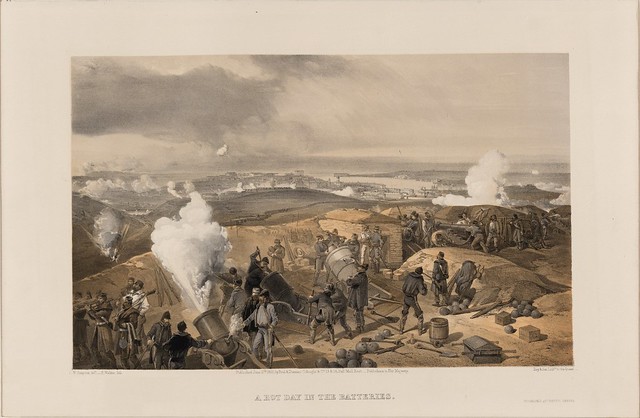
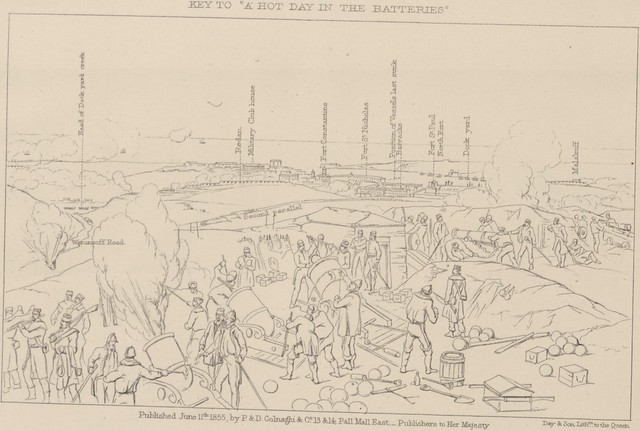
A hot day in the batteries
Key to A hot day in the batteries
A hot day in the batteries

"Print shows action in a British artillery battery, mortar fire, mortars and cannon being loaded, the removal of wounded, and in the distance, the fortifications of Sevastopol."

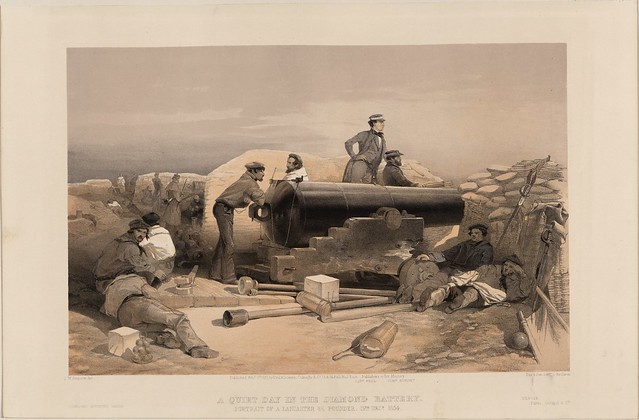
A quiet day in the diamond battery - portrait of a Lancaster 68 pounder, 15th Decr. 1854
A quiet day in the diamond battery - 
portrait of a Lancaster 68 pounder, 15th Decr. 1854

"Captain Peel, son of Sir Robert Peel, stands by the Lancaster 68-pounder, while his men keep their heads below the parapet of the battery." [source]

A hot night in the batteries

"Print shows action in a British artillery battery with cannons firing and being loaded, and men bringing in supplies."

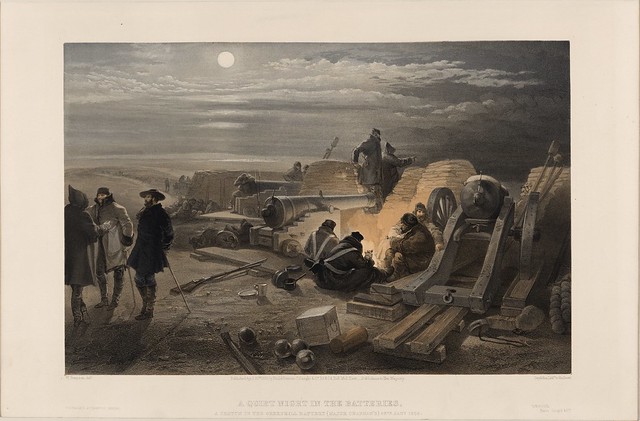
A quiet night in the batteries - a sketch in the Greenhill battery (Major Chapman's), 29th Jany. 1855
A quiet night in the batteries

"A sketch in the Greenhill battery (Major Chapman's), 29th Jany. 1855" | "Print shows men and cannons in a British artillery battery, at night."

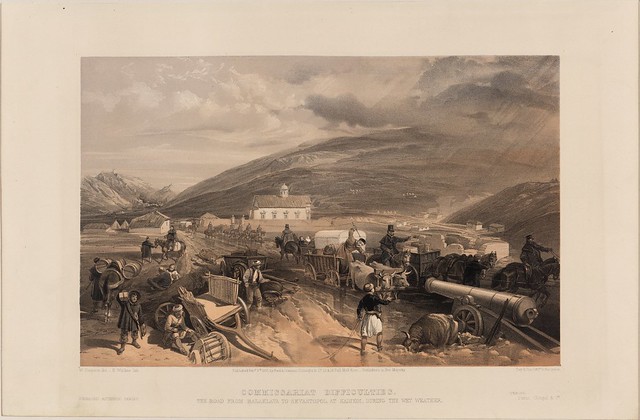
Commissariat difficulties - the road from Balaklava to Sevastopol, at Kadikoi, during the wet weather
Commissariat difficulties - the road from Balaklava 
to Sevastopol, at Kadikoi, during the wet weather

"Print shows wagons and a cannon mired in mud, broken wagons, and dead or dying horses and oxen on the roadside, at Kadikoi, on the road to Sevastopol"

Embarkation of the sick at Balaklava

"[This] tinted lithograph, [..] shows injured and ill soldiers in the Crimean War boarding boats to take them to hospital facilities. Modern nursing had its roots in the war, as war correspondents for newspapers reported the scandalous treatment of wounded soldiers in the first desperate winter, prompting the pioneering work of women such as Florence Nightingale, Mary Seacole, Frances Margaret Taylor and others." [source]

Excavated church in the caverns at Inkermann - looking west

"Print shows interior view of cavern church showing remains and two soldiers firing over a wall at the entrance to the cavern."

Highland Brigade camp, looking south
Key to Highland Brigade camp, looking south
Highland Brigade camp, looking south

"Print shows an artillery battery with Capn. Mansfield, Major Shadwell, Lieut. Col. Stirling, Major Gordon, and Sir Colin Campbell standing near the cannons, with the camp of the Highland Brigade, showing huts and tents, in the background; the harbor at Balaklava and the remains of the old Genoese castle are visible in the distance on the right."

Sentinel of the Zouaves, before Sevastopol
Sentinel of the Zouaves, before Sevastopol - The seat of war in the East

"Print shows a soldier standing guard at a French battery with snow-covered cannons and Zouaves carrying bundles of wood to a camp in the background." & "Two sentinels with fixed bayonets patrol a gun emplacement, while three figures cross the area carrying firewood" [source]

The cavalry affair of the heights of Bulganak - the first gun, 19th Sepr. 1854
Key to The cavalry affair of the heights of Bulganak - the first gun, 19th Sepr. 1854
The cavalry affair of the heights of Bulganak - the first gun, 19th Sepr. 1854

"Print shows expansive view of the countryside, the Russian cavalry and artillery in the distance, Russian guns opening fire on British troops as they draw up into formation."

The new works at the siege of Sebastopol on the right attack - from the mortar battery on the right of Gordon's battery
Key to The new works at the siege of Sebastopol on the right attack - from the mortar battery on the right of Gordon's battery
The new works at the siege of Sebastopol on the right attack - 
from the mortar battery on the right of Gordon's battery

"Print shows a mortar battery with soldiers, two mortars, gabions, and earthworks, with a distant view of Sevastopol." & "Guns and ammunition being prepared for action behind earthworks in the foreground, the Russian defences are visible in the distance." [source]


Google books limited excerpt from: 'The Campaign in the Crimea. An Historical Sketch' 2002 by George Brackenbury.


[unless otherwise stated, all commentary above is quoted or paraphrased from the LoC]
--click through on any image above for a greatly enlarged version--

"The Crimean War, famed for the 'Charge of the Light Brigade', would fundamentally alter the balance of power in Europe and set the stage for World War One" - The Crimean War By Andrew Lambert at the BBC History site.

The BM biography of William Simpson: "Draughtsman, early lithographer, watercolour painter, journalist and antiquarian. Covered the Crimean war on behalf of Colnaghi's but later joined the 'Illustrated London News' and covered the Abyssinian campaign (1868), Franco-Prussian war, Modoc war (1873) and Second Afghan war. Buried in Highgate Cemetery in London. A number of watercolours made by Simpson during his time in the Crimea, Magdala and Afghanistan are in the British Museum, along with a small number of archaeological and ethnographic items."